In an article published at Environmental Research Letters, ‘Carbon Removal, Mitigation Deterrence and the Politics of Target Separation. Evidence from the EU 2040 Climate Target Negotiation’, Alina Brad and Etienne Schneider have explored the political aspects of the process shaping the determination of the EU’s 2040 climate goal as a barrier to tackling potential mitigation deterrence by environmental policy-makers through separating targets fixed for CDR and emission reductions. In doing so, they have utilized data gathered from the consultations carried out by the EU, document examination, interviews with experts and online events. They have concluded that the actors involved, including those operating business enterprises, prevalently favor separate targets for emissions reductions and removals over a net climate goal including both targets based on different motivations. They also identify the political drivers that led the European Commission to not to embrace separate targets in its communication regarding 2040 climate goals. The study finds that the European Commission viewed separate targets to be overly complicated, rigid and possibly expensive due especially to the intensifying societal opposition against environmental policy, detrimental effects that may be suffered by the EU’s growth and competitiveness and strong demands pushing for regulatory simplicity and lack of legislation. The outcomes of the article contribute to the studies on the political economy of CDR and empirical approaches to mitigation deterrence and stress the exigency to continue investigating the manner in which political barriers against establishing separate targets can be overcome.
Key takeaways:
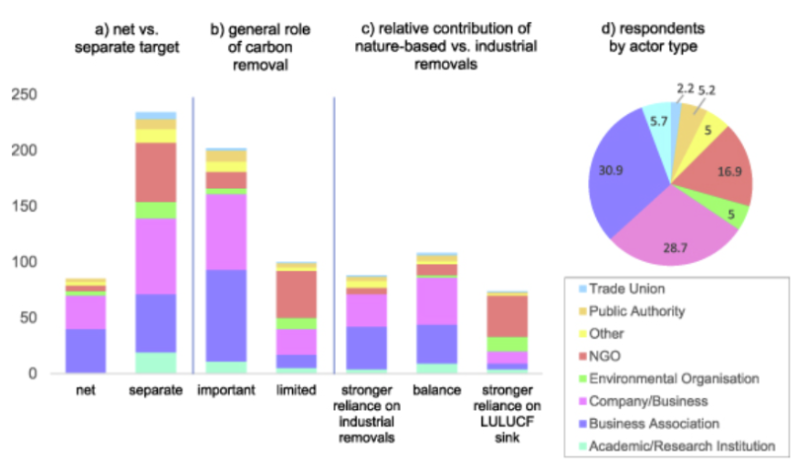
- Reviewing the inputs provided by various stakeholders to the consultation process guided by the European Commission regarding its 2040 climate goals, the authors noted that the stakeholders prevalently favor separate targets over a net target (%58.4). In addition, they highlighted that only around 20 % of the stakeholders support a net target and the rest of them have not provided a reply. Moreover, they stressed that the majority of the stakeholders (172) opted for having three separate targets for emission reduction, nature-based CDR and industrial CDR. In this regard, only 62 respondents favor a two-goal model dedicated to emission reductions and CDR.
- As far as the choices made by different stakeholder groups are concerned, the authors have noted that NGOs, environmental organizations and academic/research institutions predominantly favor having separate targets (77.9 %, 75% and 82.6 %). They have contrasted this outcome with the position of business stakeholders the overwhelming majority of which are proponents of a net target (81.2%), although 41.9 % of business associations and 59.1% of companies lended support for target separation. Importantly, the Commission’s framing of the net target as a cost-effective tool for achieving climate neutrality during the consultation process might have affected the outcome.
- The authors have determined that the stakeholders have prevalently opined that CDR has an important, rather than limited, role in enabling the EU to reach its 2050 climate neutrality goal. That said, they have pointed out that NGOs and environmental organizations mostly opine that CDR has a limited role (61.8 % and 50%) while business associations and companies attach more importance to the role of CDR (66.1% and 59.1%). In addition, they have underlined that academic/research institutions do not overwhelmingly opine that CDR has an important role. In assessing these inputs, the authors have concluded that the descriptions used during the consultation process might have affected the outcome as the EU Commission has associated the CDR with the expansion of EU clean industry and environmental co-benefits.
- In relation to the relative contribution of nature based and industrial removals, the authors have noted that stakeholders have supported both of the options to a similar extent, with the balanced approach having a slightly higher number of supporters. However, they have also underlined that while NGO and environmental organizations mostly prefer nature-based CDR methods, business stakeholders predominantly support industrial matters or the balanced approach.
- The authors have identified that stakeholders supporting a net target have relied on different motivations, namely cost reduction, simplification, preventing a singular focus on residual emissions and integrating carbon removals into the Emission Trading Scheme. In addition, they have set out that stakeholders advocating for target separation have argued that a target dedicated to CDR provides a significant and unambiguous political message for the uptake of CDR and hinders mitigation deterrence. As far as the assertion in favor of establishing separate targets for nature-based and industrial CDR is concerned, the authors have indicated that the stakeholders belonging to this group have argued that the formulation of such goals would ensure that industrial CDR options can benefit from support tailored to their exigencies.
- The authors have concluded that the EU’s reluctance to embrace separate targets stem from its willingness to render environmental policies less complicated, establish lax regulatory requirements and prevent the adoption of rigid rules shaping the obtainment of climate goals within the context of growing societal reaction to environmental policies and concerns about competitiveness.
Read the full paper here: Radware Bot Manager Captcha