In an article recently published at Sustainability, ‘Carbon Farming in Turkiye: Challenges, Opportunities and Implementation Mechanism’, a group of authors led by Abdussamet Aydin have studied various aspects of carbon farming in Turkiye by carrying out a literature review.
Key takeaways:
- Agricultural activities not only emit GHG emissions but also sequester them. Therefore, the introduction of methods suitable for sustainably managing agricultural lands and production is of crucial importance for simultaneously reducing emissions and bolstering the carbon absorption capacity of soils and vegetation through carbon farming.
- In Turkiye, a significant share of GHG emissions originate from agricultural activities involving livestock, fertilizer utilization and soil management, bolstering the potential of sustainable agriculture activities.
- Pursuing the goals of the Paris Agreement and European Green Deal, Turkiye can engage in carbon farming and enhance soil productivity, counter droughts and bolster future sources of nutrition.
- Carbon farming practices can be tailored to the exigencies of the locations where they are applied, with some definitions involving both agricultural and forestry methods. Various approaches that are applied as part of carbon farming may not always deliver net reductions in GHG emissions and must be applied by taking into account other environmental objectives.
- In addition to being an environmental measure, carbon farming represents a business model in that farmers receive financial rewards in cases where they reduce or create conditions for the absorption of GHG emissions. That said, the valuation of carbon credits as well as the implementation of MRV schemes are expensive and complicated, disincentivizing the participation of farmers. To address this shortcoming, farmer cooperatives and entities playing an intermediary role can take steps geared towards merging small projects so as to alleviate costs. These efforts should be coupled with fair allocation of carbon credit income among farmers and bolstering farmers’ trust in carbon markets.
- No single carbon farming approach can be applied everywhere in Turkiye. Instead, carbon farming practices should be adopted to the regional characteristics of different locations.
- The integration of carbon farming into local agricultural practices poses difficulties in situations where suitable institutions and monitoring schemes are absent. There are ecological and technical enablers that can facilitate Turkiye’s adoption of carbon farming. That said, it faces governance, economic and informational obstacles that prevent the realization of carbon farming.
- Turkiye has adopted a MRV system that is coherent with the requirements set by the EU but poses difficulties in terms of additionality, durability, reversal risks, costly certification procedures and long-term monitoring. This situation is exacerbated by the lack of a national regulation on carbon certification.
- Therefore, Turkiye should set an adequate MRV framework involving both digital surveillance and declarations obtained from farmers, adequate reporting in line with national and international benchmarks, third-party verification, region-specific applications, institutional coordination and capacity building as well as fiscal rewards.
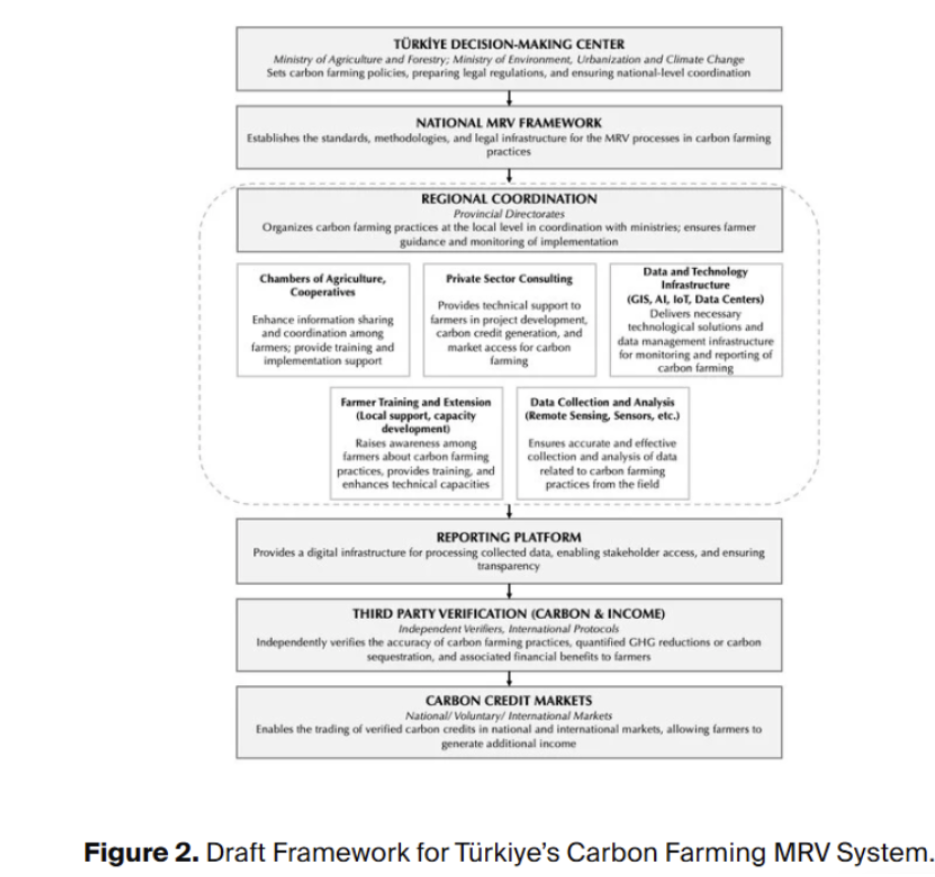
- The adoption of the Climate Law is anticipated to considerably drive agricultural demand for carbon farming in Turkey. Therefore, it is important that the relevant secondary legislation is adopted in a timely manner and necessary arrangements are made in relation to the Turkish Emissions Trading System foreseen in the Climate Law.
- Future research can adopt empirical approaches to study the stances of farmers and reactions to various carbon farming approaches. In addition, it can carry out pilot studies involving stakeholders from different sectors to offer lessons regarding institutional dynamics, coordination tools and participation. Lastly, it can associate carbon farming approaches with specific MRV indicators, monitoring approaches and data requirements.
Read the full paper here: https://www.mdpi.com/2071-1050/18/2/891#Conclusions