In a policy brief published by the European Roundtable on Climate Change and Sustainable Transition, ‘Bioenergy with Carbon Capture and Storage in the EU - Challenges and Opportunities’, a group of researchers led by Andrei Marcu have studied the deployment of bioenergy with carbon capture and storage (BECCS) in the European Union, particularly the way in which it can facilitate the achievement of environmental goals as well as the obstacles and possibilities related to its use. In doing so, they have provided an analysis of the EU policy frameworks with a focus on the Carbon Removals Certification Framework (CRCF), Renewable Energy Directive (RED), Regulation on Land Use, Land Use Change and Forestry (LULUCF) and possible integration with the EU Emissions Trading System (EU ETS). Moreover, they have stressed the technical, physical, monetary and governance-related obstacles standing in the way of the implementation of BECCS in the EU.
Key takeaways:
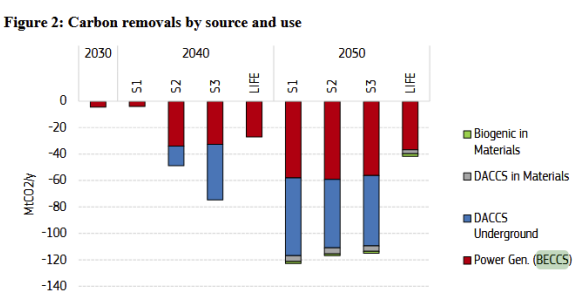
- The modelling studies conducted by the European Commission regarding the steps that should be taken for decreasing the net amount of greenhouse gas emissions by 90 % until 2040 attach importance to permanent CDR methods including BECCS. Accordingly, by 2040, BECCS is anticipated to reach a stage where it can remove up to 33 Mt of CO2 annually. The estimations for the use of BECCS together with Direct Air Carbon Capture and Storage (DACCS) vary between 16 MtCO2 (S1 scenario) and 155 MtCO2 (S3 scenario), remaining within a range between 0.3% and 3.3% of the greenhouse gases emitted by the EU in 1990.
- The CRCF introduced the first voluntary certification scheme for carbon removals at the EU level. In order to guarantee environmental integrity, the regulation sets out several criteria. Accordingly, BECCS activities should result in net carbon removal benefit. In addition, they should not only meet regulatory requirements but also benefit from other incentives to receive funding. Moreover, permanent carbon storage with a duration of several centuries must be verified through the application of requirements regarding monitoring so that reversals can be tackled with. Lastly, BECCS activities should not excessively hamper the achievement of environmental goals and produce co-benefits.
- Under the RED, biomass utilized for energy generation must not be gathered from areas with environmental vulnerability such as certain forests, areas possessing a high degree of capacity to store carbon and agricultural fields safeguarded under EU and local laws. In addition, crops used as biomass should be gathered in a sustainable manner so as not to hamper the carbon absorption capacity and biodiversity of forests. Lastly, those generating energy through the use of biomass must achieve a minimum amount of greenhouse gas emissions savings compared to fossil fuel production.
- The LULUCF Regulation introduces rules regarding emissions and removals emanating from the land use sector during the period spanning from 2021 until 2030. Under this framework, member states should guarantee that the amount of emissions are not higher from removals originating from land use. As a result, net emissions resulting from activities carried out to set out facilities for bioenergy production should be compensated by CDR methods employed in the LULUCF sector. The LULUCF regulation establishes an EU-level goal of reaching a net CDR amounting to 310MtCO2 by 2030 compared to the CDR obtained during the time period spanning from 2016 until 2018.
- The EU ETS introduces the EU’s main cap-and-trade system for decreasing the amount of greenhouse gas emissions originating from power production, industry and aviation. Within this context, this framework establishes a decreasing cap on the total amount of emissions and generates allowances that must be used by entities to account for their emissions. Currently, the EU ETS does not incorporate CDR. However, if amendments that may be made to the EU ETS in 2026 integrate CDR to this framework, dual goals may be established for emission reductions and CDR and the cap may be changed through the introduction of a budget for net negative emissions after 2040.
- There are obstacles preventing the adequate deployment of BECCS irrespective of the place of implementation that stem from the features possessed by this technology such as the inefficiency of capture technologies. Other challenges, however, are faced due to the potential deployment of this technology in the EU. In this regard, BECCS deployment is not integrated to the EU ETS, meaning that the implementation of this technology does not result in the generation of credits or financial incentives. In the absence of a framework for financing negative emission technologies, BECCS activities cannot generate funds to cover their capital needs and operational expenses. That said, even if BECCS were incorporated into the EU ETS, the allowance prices would be inadequate for bolstering its implementation. To address this shortcoming, Carbon Contracts for Difference guaranteeing a stable carbon price during a certain timeframe can be utilized.
- The strict sustainability requirements imposed under the RED significantly constrain the potential uptake of BECCS implementation in the EU.
Read the policy brief here: Policy Brief: Bioenergy with Carbon Capture and Storage in the EU – Challenges and Opportunities – ERCST