In an article recently published at Springer Nature, ‘Bioenergy Carbon Capture Storage and Utilization: A Critical Review of Market Dynamics and Policy Implications’, a group of authors led by Dig Vijay Singh have presented pathways to enable the deployment of bioenergy with carbon capture, utilization and storage (‘BECCUS’) with a focus on market tools, technological novelties and integration across different sectors in both developing and developed states. In doing so, they have called for policy changes geared towards setting out a transparent system in relation to carbon pricing, emission tradition systems and adequate certification tools for biogenic carbon use. If the renewable energy systems can be integrated following the realization of these changes, barriers standing in the way of BECCUS deployment can be overcome. In addition, the economic viability and sustainability of BECCUS deployment would be enhanced.
Key takeaways:
- BECCUS, a type of bioenergy with carbon capture and storage (‘BECCS’), utilizes biogenic CO2 that decreases carbon emissions and creates more revenue compared to BECCS that relies on CO2.
- The BECCUS regulations that are currently in force are not suitable for drawing extensive BECCUS deployment due to the cross-cutting nature of this technology at the intersection of energy, environmental and agricultural sectors.
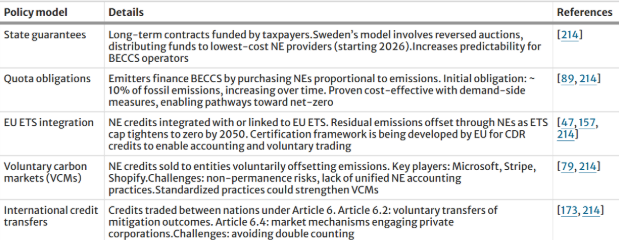
- The implementation of financial incentives such as carbon credits and government subsidies is essential for ensuring the viability of BECCUS. The facilitation of BECCUS deployment is contingent upon ensuring that market exigencies and research goals are aligned. In addition, inclusive decision-making processes, amplified interaction among market actors, scholars and policymakers as well as augmented public support will play a crucial role in the deployment of BECCUS. More policies such as renewable energy certificates and contracts for difference between renewable and fossil products would increase BECCUS deployment. Market frameworks generating demand for biogenic CO2 and facilitating the generation of their environmental benefits should be set up.
- The released CO2 and fermentation should be treated as a renewable resource replaceable with fossil-based CO2, thereby being subject to advantageous rules as part of carbon accounting systems and carbon markets. Creating a robust certification framework for carbon removals will drive trade in carbon credits that foster transparency, presenting financial benefits for using and maintaining biogenic CO2 in construction tools or underground. In addition, uniform policy tools are crucial for expanding the scaling of BECCUS given that the status quo is marked by a piecemeal approach to BECCUS. In this regard, regions should be provided with uniformly applicable methodologies to evaluate carbon emissions and economic viability. Carbon taxes or emission trading schemes whose implementation does not vary across regions and common approaches to biomass obtainment, transfer and maintenance will provide foreseeable markets for carbon removals created by BECCUS, driving investment. Notably, international cooperation should be ensured to account for transnational effects such as exchange of biomass or facilities maintaining CO2 located in more than one jurisdiction. Moreover, bioenergy policies should be aligned with renewable and climate goals given that BECCUS is deemed as one of the most influential CDR tools.
- Carbon tax must be applied at the global level in a strict manner. It can act as a catalyst for carbon capture and storage technologies. While 54 countries have started applying carbon tax, a number of countries have not taken measures for its implementation.
Grants should be allocated for BECCUS research and development to improve its technological readiness levels. States should set permit mechanisms regarding carbon capture, transport and storage and rules in relation to environment impact assessment of BECCUS. Moreover, the party that can be held liable for stored carbon following project realization should be clearly identified. - Creating a biomass map of various crops with seasonal production and availability at regional scales can illustrate the viability of projects and drive investors to support the BECCUS sector.
- Collaborative research activities carried out by different countries and cross-sector research should be prioritized given the cross-sectoral nature of BECCUS and divergent competences possessed by countries.
Read the full paper here: Bioenergy carbon capture storage and utilization: a critical review of market dynamics and policy implications | Biotechnology for Biofuels and Bioproducts | Springer Nature Link