In a policy brief published by the Greenhouse Gas Removal Hub, ‘Biochar Regulation in the UK: A Wasteful Approach to Greenhouse Gas Removal’, Luka Strubelj and Navraj Singh Ghaleigh have laid down recommendations for the amelioration of biochar regulation in the UK.
Key takeaways:
-
Greenhouse gas removal (GGR) methods, whose use is essential for achieving the temperature goals of the Paris Agreement while ambitious emission reductions are underway, sequester greenhouse gases from the air and maintain them during time intervals spanning from decades to thousand years.
-
Use of biochar for GGR purposes presents the opportunity to sequester carbon during a long time interval without incurring excessive costs. In addition, it offers agriculture and construction related co-benefits, can be utilized as a tool for reducing emissions and does not necessitate the establishment of infrastructure for the transfer and maintenance of carbon like other engineered methods.
-
Biochar has been incorporated into the UK Climate Change Committee’s Seventh Carbon Budget pathway alongside enhanced rock weathering. These methods are anticipated to remove 3 MtCO2 annually starting from 2050 - a quantity that can satisfy around 8 % of the requirement set by the UK for engineered GGRs. That said, the current degree of deployment is considerably insufficient for the achievement of the UK’s climate goals.
-
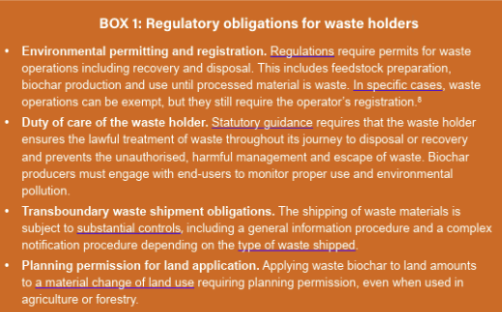
Notwithstanding the significant potential of biochar as a GGR technology, policy making and regulatory activities pertaining to biochar suffer from shortcomings. Under the relevant framework, biochar is deemed as waste if it is produced from ingredients that are not considered to be of any use. However, biochar can gain the characteristics of waste further down the value chain in cases where the main goal of its production relates to the obtainment of pyrolysis co-products that require a high amount of energy. Therefore, in these cases, biochar is categorized as waste, save for the situations where the requirements of certain tests comparing the environmental risks of biochar with biochar that does not amount to waste are met.
-
The realization of the aforementioned test entails considerable transaction costs in the absence of standards apart from voluntary guidelines within a framework shaped by case-specific evaluations. Processes and regulatory requirements pertaining to waste in the UK are ambiguous and vary across UK jurisdictions, which may lead biochar to attract less attention as a GGR method.
-
The imposition of obligations and costs without the establishment of rules for environmental protection purposes jeopardized the potential of biochar as a GGR technology in the UK in contrast to the EU that has taken important steps for the scaling of biochar.
-
To tackle these challenges, the UK Environment Agency can adopt standards pertaining to end-of-waste and by-product biochar as well as rules for pyrolysis facilities. The introduction of such rules would considerably mitigate legislative ambiguity for entities using biochar as a GGR method. Alternatively, a detailed biochar framework including all biochar-related rules applicable in the UK can be introduced. The pursuance of this option would lay down requirements regarding the standard use of non-waste biochar, guarantee unified access of biochar across the UK and establish quality standards for imported biochar.

Read the full policy brief here: https://co2re.org/wp-content/uploads/2025/06/biochar-waste-regulation-pb.pdf