This week, we deep dive into a paper recently published in Nature Communications. The study was led by Yitao Li, affiliated with the Chinese Academy of Sciences and the Department of Earth System Science of the Institute for Global Change Studies of Tsinghua University, in Beijing (China).
In addition to the global impacts, forests exhibit local cooling or warming effects. These effects have recently gained attention as they have the potential to significantly intensify or offset the climate mitigation effects of carbon sequestration. Recent satellite observations revealed trends suggesting that the biophysical influence of forests is not static but changes with climate. In this paper, satellite observations of spatially nearby forests and openlands over the last two decades are combined to quantify temporal trends in local land surface temperature (LST) effects of forest change in Europe, hence to understand whether and to what extent local temperature effects evolve in response to climate change.
One of the key original contributions of this work is the detection of temporal trends in the biophysical temperature effects of forestation, based on observations rather than solely modeling. Previous studies often assessed how forests alter local land surface temperature (LST) in a spatial or seasonal snapshot, or used models to forecast how those effects might shift under warming scenarios. In this paper, forests and proximate open lands are compared over ~20 years (2004–2023) using MODIS satellite data from and a space-for-time design, which enables to quantify how the difference in surface temperature responses is evolving. This fills a methodological gap: directly measuring how the cooling or warming influence of forests is changing over time in the real world, not just in models. The authors also tie these observed trends to underlying biophysical mechanisms (albedo shifts, evapotranspiration resilience, soil moisture) and test whether Earth system models reproduce such trends, revealing mismatches.
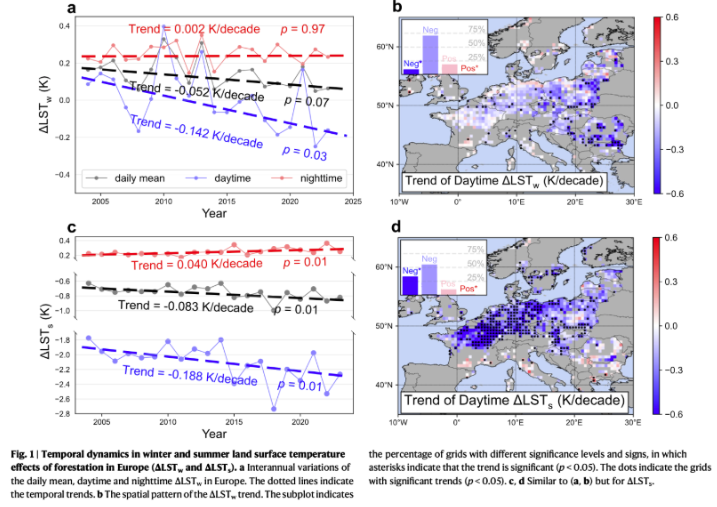
Historically, forests exhibit a slight net warming effect in winter and a cooling effect in the summer. During the study period, the daytime winter warming effect weakened, eventually shifting toward cooling, largely because open lands darken more (lose albedo) than forests as snow cover declines. Winter nighttime forest warming effects, instead, remain largely unchanged. Study data reveal that in the summer, forests exert strong daytime cooling; over time, this cooling effect becomes stronger, as forests better resist soil moisture stress and maintain evapotranspiration while open-lands suffer more drought effects. The net daily LST difference thus shows an intensified cooling trend. Structural equation modeling points to soil moisture deficits (and vapor pressure deficit) acting via enhanced greenness (leaf area) and latent heat flux differences between forests and open lands as key mediators. When comparing to CMIP6 Earth system models, the authors find that while multi-model ensembles can somewhat reproduce cooling trends, many models diverge in magnitude and mechanistic pathways, especially regarding the role of soil moisture in summer.
Here is a list of the main takeaways of this paper:
- Over the last ~20 years, daytime warming effects of forestation in European winters have weakened and shifted toward cooling, driven by less pronounced darkened areas when compared to open lands.
- In summer, forests’ daytime coolinppppg relative to open lands has intensified, as trees maintain evapotranspiration under increasing dryness.
- Soil moisture deficits (coupled with vapor pressure deficit) emerge as dominant drivers of the summer trend, acting via stronger greenness and latent heat flux differences between forest and open vegetation.
- The observed trends show that biophysical temperature effects of forests are not static but evolve with climate change, demanding that forest-climate policy consider temporal dynamics beyond carbon uptake.
- Earth system models capture the general sign of cooling trends but differ substantially in magnitude and mechanisms (especially in summer), underscoring the need to improve model parameterization of snow–forest and soil moisture processes.
Read the full paper here: Amplified local cooling effect of forestation in warming Europe