In a recently published concept paper, ‘A Trust for Permanence: Enabling a New Generation of Permanent Nature-Based Credits in the Voluntary Carbon Market’, Nathan Truitt and Lynn Riley from the American Forest Foundation have examined the tools that have been developed to guarantee the permanence of natural climate solutions (‘NCS’), particularly forest-based NCS, and have presented the Permanence Trust, a new tool that can be used for this purpose.
Key takeaways:
- The implementation of NCS safeguarding ecosystems and offering environmental benefits is of vital importance for meeting the temperature goals of the Paris Agreement.
- A voluntary carbon market (‘VCM’) can only function adequately if the carbon removed via NCS remains sequestered for a certain period of time, a requirement that has come to be known as permanence.
- Notwithstanding the presence of tools guaranteeing a certain degree of permanence in the rules regarding carbon crediting, the credits issued in VCM, particularly NCS credits, have faced backlash due to their lack of permanence resulting from risk of reversal.
- The risk of reversal hampering the reliability of NCS has led technological CDR methods to receive great attention. Despite being much more permanent compared to NCS, there are four barriers to the implementation of technological CDR to the exclusion of NCS. First, they are quite costly. Second, they are not scaling quickly, thereby failing to enable the achievement of the temperature goals of the Paris Agreement by imminently removing great amounts of carbon. Third, their use can downgrade and postpone the use of NCS, decreasing the amount of carbon removed and maintained by them as significant long term sinks. Lastly, technological CDR methods do not have the advantages offered by NCS such as blocking the release of emissions from biogenic carbon stocks.
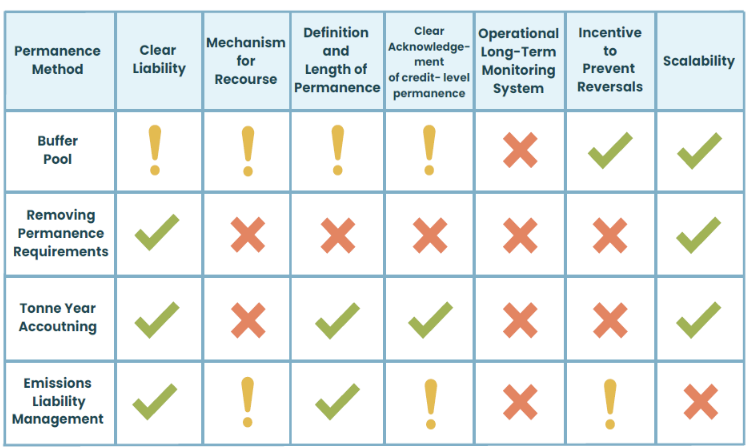
- The tools that are currently being used to tackle the risk of reversal in NCS include buffer pool, removing permanence requirements, tonne year accounting and emissions liability management.
- However, the aforementioned tools do not satisfy all of the requirements introduced in the paper for guaranteeing permanence, namely ‘clear liability, mechanism for recourse, definition and length of permanence, clear acknowledgement of credit-level permanence, incentive to prevent reversal and scalability’.
- Other principles that should be abided by in ensuring permanence are ‘transparency, simplicity, rigor, solvency, feasibility, efficiency and longevity.’
- The Permanence Trust has been created by building on existing tools and principles. Instead of making assumptions regarding the amount of climate mitigation that should be secured in the present to compensate for the risk of reversal in the future, however, it makes use of models forecasting the amount of financing required in the present that can be used in the future to proactively tackle the risk of reversal.
- In doing so, the Permanence Trust utilizes climate finance to ensure the adoption of a novel model of forest management by landowners that can preserve itself rather than paying landowners to undertake a task they would normally not be willing to carry out. Within this context, to address the risks landowners would face in the future when their contracts expire, it created a fund made up 10% of the earnings from the sale of carbon credits that gradually grew through investments.
- There are some challenges posed by the operationalization of the Permanence Trust due to the ambiguities pertaining to its establishment in the market, required transformation of the rules to meet its exigencies, its legal nature, the risk of insolvency, definition and monitoring of reversal.
Read the full paper here: https://www.ecosystemmarketplace.com/articles/release-new-report-details-innovative-approach-to-permanence-for-natural-climate-solutions/