In a report published on its website, ‘A Policy Framework for Scaling Up Permanent Carbon Dioxide Removal in the United States’, Clean Air Task Force has presented a framework for creating a suitable policy mix that can be used for ensuring the uptake of permanent CDR in the US.
Key takeaways:
- Under the Innovation Technology Framework, policy-makers should consider the changing features of a given technology as it passes through four phases.
- During the first phase, R&D, scientists demonstrate that the technology can be deployed at large scale.
- During the second phase, early output, first deployments of the technology take place. The number of the projects that are operationalized can vary depending on the features of the technology in question. While the first project is usually costly, the project prices drop gradually as more deployments are completed by the end of this phase.
- During the third phase, commercialization, technological risks and costs decrease and commercial financing becomes accessible, enabling the technology to reach the take-off point.
- During the last phase, take-off point, the technology reaches full maturity, both technically and commercially.
- The successful completion of these phases depends on the employment of policies that decrease costs, facilitate access to finance, accelerate project development and overcome ecosystem barriers by boosting public acceptance, creating standards and enhancing certification and monitoring.
- CDR technologies have different features in terms of additionality (completion of a carbon removal activity owing to a given policy measure employed with the goal of facilitating its realization), measurability, scalability and environmental and social sustainability.
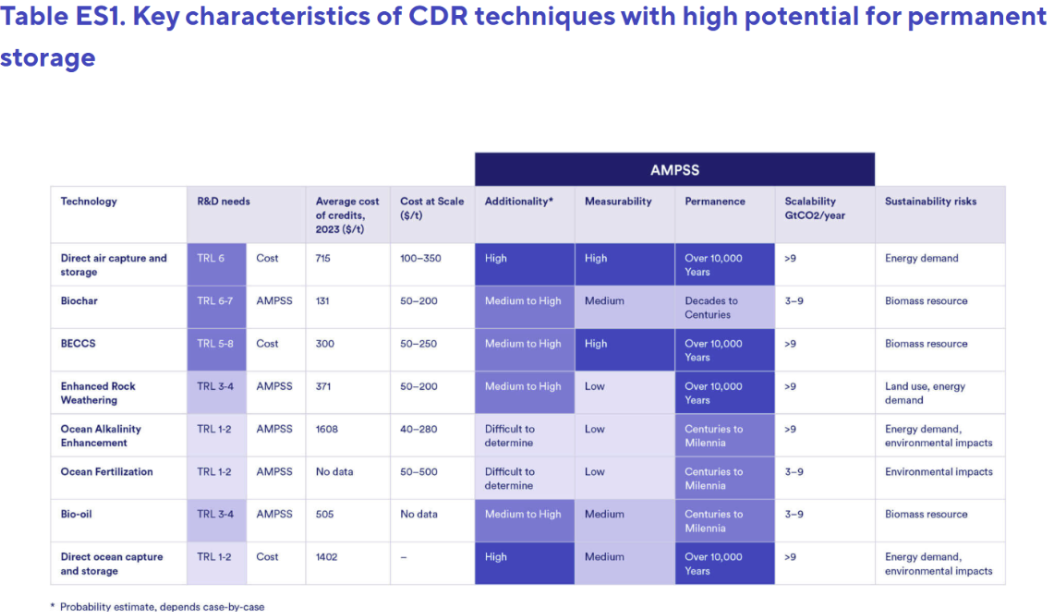
- During the R&D phase, a wider range of CDR technologies should be considered. In addition, various agencies should work cooperatively in order to develop specializations tailored for different CDR technologies and monitoring, reporting and verification processes.
- CDR funding should be made conditional to knowledge-sharing.
- Collaboration between CDR companies and scientists should be facilitated.
- During the early output and commercialization phases, incentives should be made more definitive and in certain situations their number should be reduced to ensure simplicity. Successful commercialization depends on decreasing costs and the presence of a long-term policy that can be employed swiftly such as a compliance market.
- A working group composed of CDR companies, environmental NGOs and policy-makers should be established to enhance the quantification of the take-off point for CDR and employ various policies to reach the take-off point.
Read the full report here: A Policy Framework for Scaling Up Permanent Carbon Dioxide Removal in the United States – Clean Air Task Force