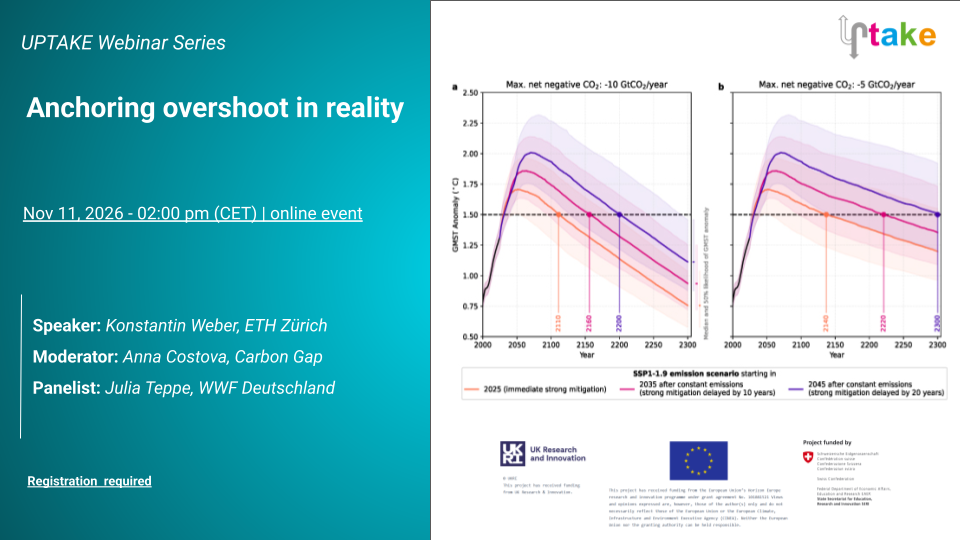
The next webinar on the latest published papers on carbon dioxide removal (CDR) research will focus on the paper Anchoring overshoot in reality
 Speaker: Konstantin Weber, ETH Zürich
Moderator: Anna Costova, Associate Policy Lead, Carbon Gap
Panelist: Julia Teppe, Policy Advisor Climate and Energy, WWF Deutschland
 11 November 2026, 2 pm - 3pm (CET) I ZOOM, online
Register in advance  here.
About the paper
With 1.5°C of long-term warming very likely to be reached within the next decade or two, many studies now explore overshoot scenarios, in which warming exceeds this level and is then assumed to return quickly to a “safe” range. This Perspective, published in Environmental Research Letters (Focus on Pathways and Consequences of Climate Overshoot), argues that the cooling rate typically assumed after peak warming is too optimistic.
According to the authors, this optimism reflects misconceptions about:
- system dynamics and timescales, even among experts;
- the potential of CDR to balance historical emissions;
- the practical relevance of integrated assessment models and scenarios built on questionable assumptions.
These misconceptions feed an overly reassuring narrative that downplays the risks of long-term overshoot and suggests that today’s shortcomings can be fixed later. The paper stresses that substantial overshoot means more than a slightly bigger mess to clean up later. It could leave several future generations living above 1.5°C, with irreversible and partly uncertain impacts on ecosystems and human health. A return to lower warming remains possible in principle, but it depends on overcoming the financial and governance challenges of scaling CDR to net-negative CO₂ emissions. Given current developments, a long-term exceedance of 1.5°C, or even 2°C, appears more likely than a short overshoot.
The webinar format will consist of a 20-minute presentation and a 10-minute discussion with an invited expert stakeholder, followed by a 30-minute open discussion (1 hour total).